
· Harper Caldwell
Are radiator beds safe for cats?
From the first cold snap, the radiator becomes the most disputed spot in the house. That is normal behavior — provided contact with the metal is avoided.
Why it hunts for the warmest spot
A cat is comfortable across a temperature range higher than ours. What feels like a comfortable room to us feels cool to it, especially at rest — and according to published recordings it spends around 13 hours in every 24 asleep.
Hence the methodical hunt for warm spots: the top of a router, a laptop, a patch of sun on the floor, and of course the radiator. It is not a whim, it is energy saving.
What actually decides whether radiator beds are safe for cats
Direct, prolonged contact. A wet radiator rarely reaches a dangerous temperature, but an electric convector or a cast iron radiator turned right up can create hot spots. A sleeping cat does not move at the first discomfort: it gets used to it.
Dehydration. A cat that sleeps ten hours pressed against a heat source often drinks too little. A water bowl nearby — not next to the food, cats prefer the two apart — settles it.
Falling. The top of a radiator is narrow. A cat that stretches out in its sleep slides, catches itself, and eventually gives the spot up. That is often what explains a perfectly warm post being abandoned.
The cats this matters most for
Three profiles seek heat more than the rest: kittens, which regulate their temperature poorly; older cats, whose joints do better warm; and short-haired or thinly coated breeds.
For those three, a warm bed is not a comfort but a need. An arthritic cat that finds a warm, stable place gets up more easily in the morning.
The right setup to keep radiator beds safe for cats
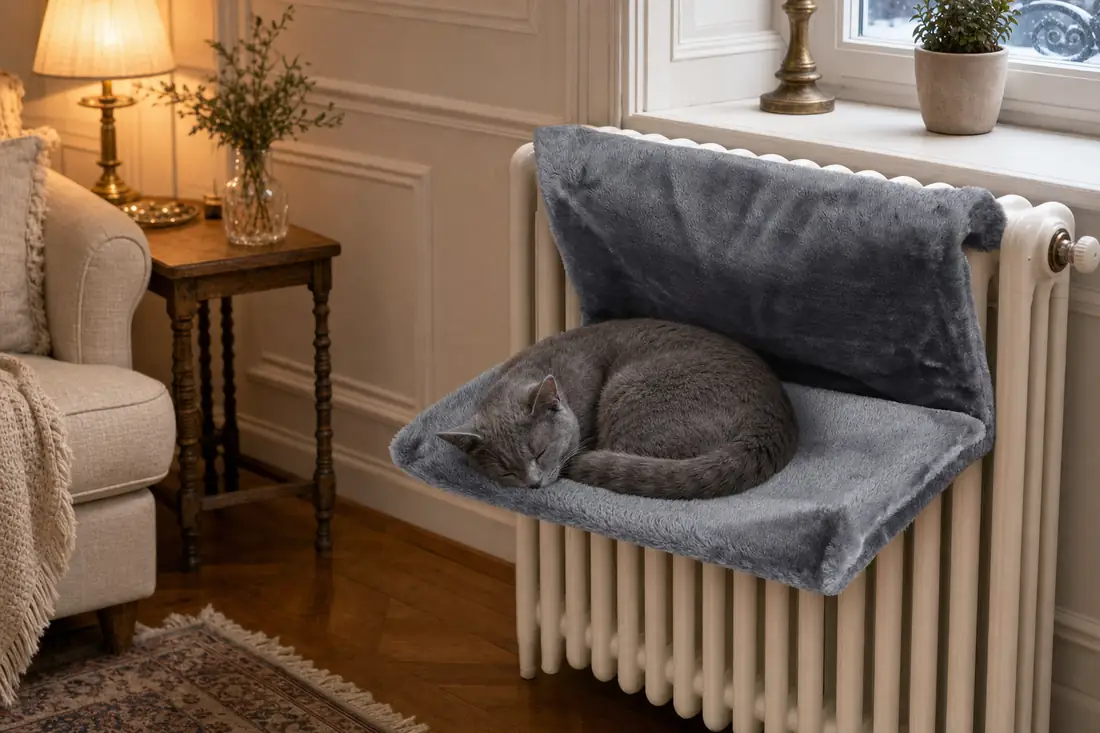
The answer is not to keep the cat away from the radiator, but to keep it off the metal while keeping the heat. That is the principle of a radiator hammock: a frame drops over the top and suspends a bed a few inches clear of the surface.
The cat gets the warm air rising past it, with no direct contact, on a surface wide enough to stretch out on. The backrest gives it the support a bare ledge does not.
One practical point: this kind of frame needs a radiator with a gap along the top. On solid cast iron the hooks have nowhere to go — better to check that before ordering than to find out when the box arrives.
And when the heating goes off
Come spring the post loses its thermal appeal but keeps its height and its view. Plenty of owners move the frame onto a balcony railing or a stair balustrade, where it hooks on exactly the same way. The bed then earns its place all year.

Harper Caldwell · Feline behaviorist — founder of Sunbask
Harper works with households living with one or more cats in flats. Her work turns on one question: where a cat chooses to settle, and why it ignores the bed you bought it. It was measuring dozens of window sills in clients' homes that led her to start Sunbask, and to the habit of publishing the measurements nobody else gives.
How hot does a radiator actually get?
The answer depends entirely on the type, which is why the danger question has no single answer.
A wet radiator on a boiler usually runs between 45 and 65 °C in normal operation, and low-temperature systems sit below 45 °C. At those values brief contact does nothing, and prolonged contact is uncomfortable well before it is dangerous — the cat moves long before that.
An electric convector heats the air, not its casing: the outlet grille can be hot while the front is far cooler. A radiant panel, on the other hand, heats its own surface — and a dry storage radiator turned right up can pass 70 °C on top. That is the category that deserves a hand laid on it before you hang anything there.
Cast iron is the deceptive one: it warms slowly, cools slowly, and stays lukewarm long after the heating goes off. A cat finds a gentle, lasting warmth there, which is why so many of them are devoted to old radiators.
The useful test is one sentence long: put your palm flat on the top of your radiator, at full output. If you can leave it there ten seconds without discomfort, your cat is fine; if you pull your hand away, fit a bed that keeps it off the surface.
Spotting a cat that is too warm
A cat regulates itself, but a sleeping cat regulates less well — that is the whole issue. The signs, from most to least common:
- It sprawls out flat, on its side, legs extended, instead of curling up. That is the first thermal response and it is entirely normal.
- It moves every twenty minutes between the warm spot and somewhere cool. That is a sign of balance, not alarm: it is doing exactly the right thing.
- It grooms far more than usual: evaporating saliva is one of its few cooling mechanisms.
- It pants, mouth open. In a cat this is not ordinary the way it is in a dog. Panting at rest warrants a call to the vet, not a rearrangement of the bedding.
What these signs have in common: they assume the cat has a choice. A warm bed is only a risk when it is the one comfortable place in the room. Always leave an alternative at room temperature and the question settles itself.
Two common mistakes
Covering the radiator completely. Throwing a blanket over it to “make a bed” is the answer that comes naturally, and it is the wrong one: it traps the heat instead of letting it rise, it wrecks the output of the radiator, and it creates precisely the hot spot you were trying to avoid. A bed hung in front of the radiator, open at the back, does the opposite.
Blocking access. Fencing off the radiator does not remove the need, it moves it — onto the top of the fridge, onto a laptop, or onto a narrow ledge the cat will fall off in its sleep. Offering a warm and stable post solves more than closing one off does.
What if the cat sleeps behind the radiator?
It is the least comfortable arrangement and the most common one: the cat slips into the few inches between the radiator and the wall, where the air is hottest and nobody disturbs it. Nothing there is dangerous in itself, but the space is tight, dust collects, and the cat comes out gray more often than not.
The behavior is telling you two things: it wants warmth, and it wants to be enclosed. A bed that answers only the first will not change its mind. A bed with a backrest, hung on the same radiator, answers both — it gives the heat and a protected back.
One last marker, good for the whole heating season: if your cat chooses a cooler spot of its own accord while the radiator is running, regulation is working and there is nothing to fix.
Why it wants that particular warmth
the cat’s thermoneutral zone — well above the 19 to 21 °C of a heated home
— Veterinary Ireland Journal, after the National Research Council, 2023
of sleep per 24 hours, measured by EEG in 18 cats
— Lucas and Sterman (1974), as reported by Campbell and Tobler, 1984
the part of the day when sleep peaks
— Sterman et al. (1965), as reported by Campbell and Tobler, 1984