
Cat perch: how many, how high, and where they actually work
This page is about the arrangement rather than a single product — how many posts a home needs, at what heights, and why the expensive one sometimes stays empty while a cleared shelf does not.
What counts as a cat perch
Less than people think, and more than they expect. A perch needs to be stable under a cat that lands on it, wide enough to lie down on, and positioned so the cat can see. Cats test a surface before settling: if it moves on the first press, they leave and do not come back easily.
That is why the top of a wardrobe already works and a wobbly wall shelf does not, however smart it looks. It is also why a cat that will not use a new post is often objecting to how it feels underfoot rather than to where it is.
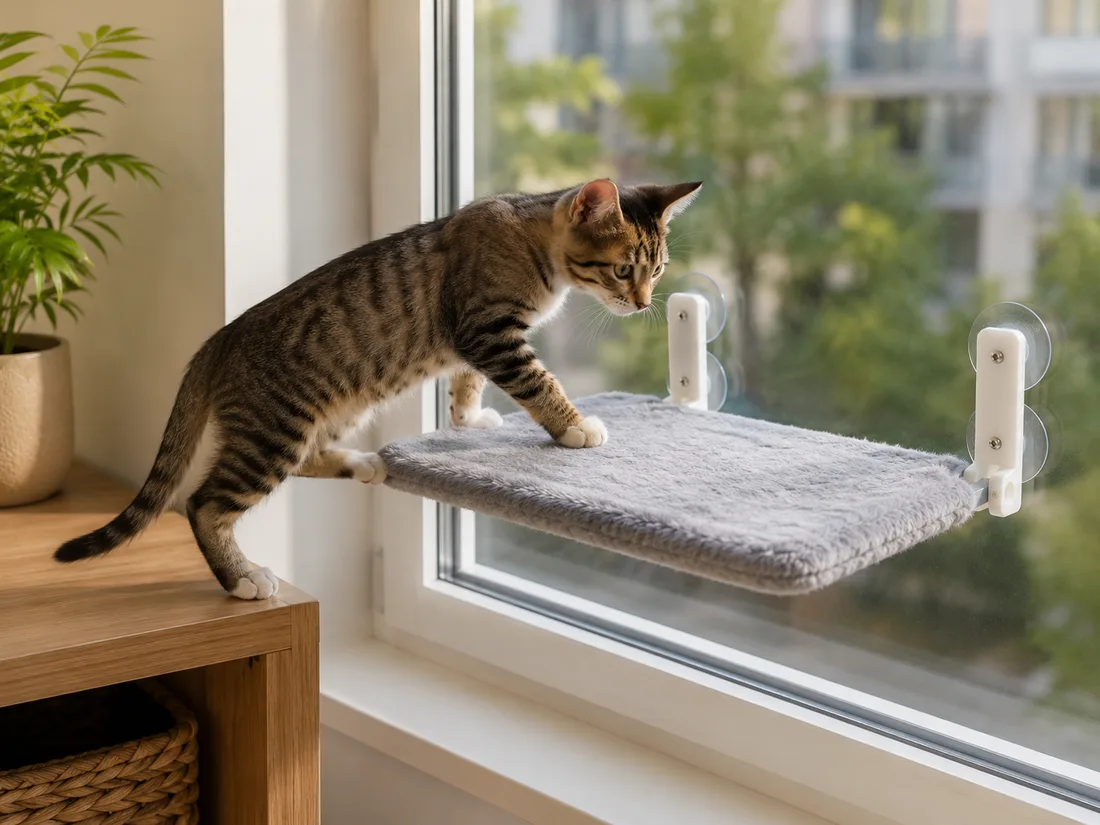
How high before it starts working
There is no standard, but there is a marker worth using: the highest post in the home should sit above the eye level of a standing adult, so around 5 ft 3 in. That is the point at which a cat stops being the one observed and becomes the observer, and it is that switch — not the inches — that produces the calm people are after.
Below it, height still helps for warmth and for staying clear of foot traffic. Above about six and a half feet you gain little and make the climb down harder. Most of the benefit therefore falls between 4 and 6 feet, which happens to be exactly where windows are.
How many, and why one is rarely enough
With a single cat, one good post changes the day. With two or more, the arithmetic changes: cats argue far less over floor space than over the high points, because whoever holds them controls the room.
The rule observed in multi-cat households is n + 1: three posts for two cats, four for three. It does not come from a need for more beds but from a need for choice — a cat lower down the order has to be able to withdraw without negotiating for it.
| Cats | Posts | What it prevents |
|---|---|---|
| 1 | 1–2 | Nothing to prevent; a second post lets it follow the sun |
| 2 | 3 | The one warm ledge becoming a point of conflict |
| 3 | 4 | A subordinate cat with nowhere to retreat to |
They do not have to be identical or cost the same. What counts is the number of distinct places and how they are spread through the home.
Think in routes, not in points
The most common mistake is to install a perch, watch it stay empty, and conclude the cat does not like height. Far more often it does not like that post's isolation.
A cat does not travel from a point on the floor to a point four feet up: it takes a route, a series of footholds that climb and come back down. Three surfaces at 16, 32 and 48 inches beat a single one at 60, even though the total height is lower. And it wants a way down that is not the way it came up — a shelf with no neighbor gets used for two days and then abandoned, which matters most in a multi-cat home where being cornered up high is a position to avoid.
Before adding anything, look at what already sits at mid-height around the spot: the arm of a couch, a dresser, the top of a radiator. You usually have nothing to buy for the intermediate step. There is more on this in our guide to vertical space in a small home.
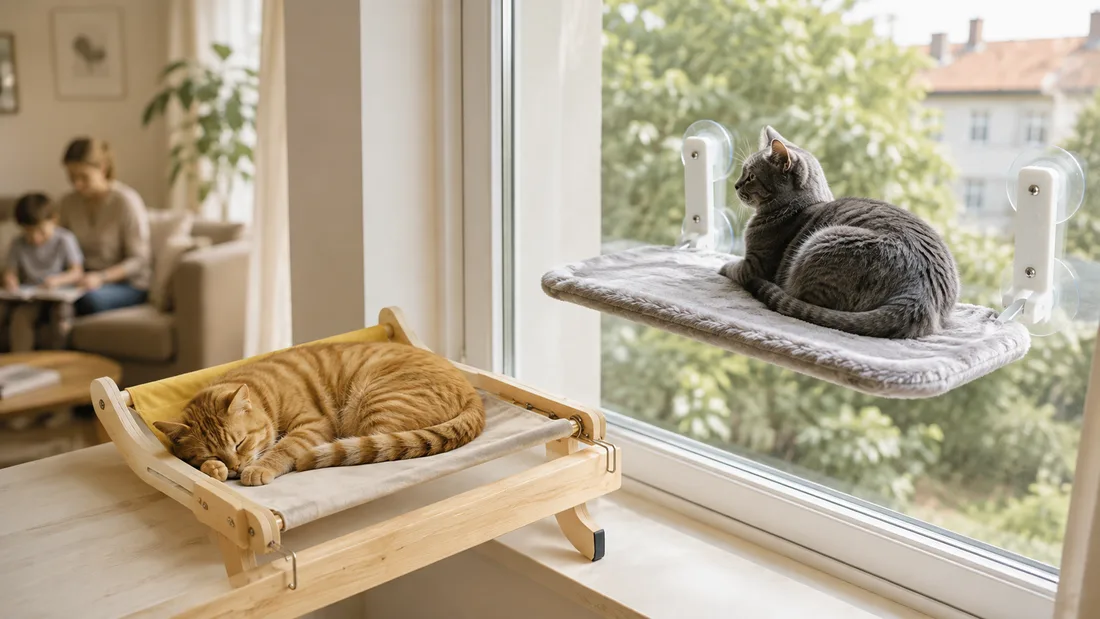
Where to put a cat perch, and where not to
Prefer a window that looks onto movement — a street, a yard, a bird feeder. A blank courtyard interests nobody, and no product rescues that. Avoid hallways and thoroughfares: a cat does not rest where people brush past it, and it will quietly stop using a post that is only reachable by crossing the busiest part of the room.
Grouping everything in one place is the other frequent error. Three posts side by side are not worth three spread out, because the point of the second is a different view, not a second seat.
The vets' own list
pillars of a healthy feline environment — access to elevated space is one of them
— AAFP and ISFM, Journal of Feline Medicine and Surgery, 2013
The same document asks that a perch be wide and long enough to let a cat stretch out fully, and describes the ideal one as having a hammock-style depression that gives a sense of concealment. Size and shape, in other words, as much as height.
Perch, cat tree, or shelf
They answer different constraints rather than competing.
A cat tree combines scratching, hiding and height in one object, but occupies a permanent footprint — a real issue in a studio — and only offers a view if it happens to stand at a window.
A wall shelf gives height with no floor footprint, but it is screwed into the wall, which rules it out of most rentals and makes it hard to move when you find out the first position was wrong.
A window perch takes no floor space and puts the cat where the view is. Ours mount three ways with nothing drilled: suction cups on the glass, a clamped wooden frame on a sill, or a frame hooked over a radiator. The comparison of the three works through which suits which window.
Giving a new perch its three days
A cat inspects anything new before lying on it, and puts on a convincing show of indifference meanwhile. Give it three or four days. Two things speed it up markedly: putting something on the surface that already smells of the cat, and fitting the post while the cat is in the room rather than letting it discover an object that appeared during an absence.
Common questions about cat perches
How many perches does one cat need?
One is enough for a single cat, but the useful rule in multi-cat homes is n + 1: three posts for two cats, four for three. It comes from a need for choice rather than for beds — a subordinate cat has to be able to withdraw without negotiating.
How high should a cat perch be?
The highest post in the home works best above the eye level of a standing adult, around 5 ft 3 in. That is where a cat stops being the one observed and becomes the observer. Most of the benefit sits between 4 and 6 feet, which is exactly the band a window occupies.
Do the perches have to match?
No, and it is better if they do not. A cat wants different vantage points, not a row of identical seats. A cleared wardrobe top, a freed shelf and a window perch make a perfectly good set.
My cat ignores the perch I installed. Why?
Almost always placement rather than product: a window facing a wall, a thoroughfare, or a height with no stepping stone. Move it before concluding the model is wrong, and give it three or four days.