
Cat window seat: fitting one to the sill you already have
Most people asking about a window seat already have the window and want to know what will fit it. So this page starts from the sill, not from the catalog.
Measure the sill first
Three numbers decide, and they take a minute with a tape measure.
Depth of the ledge. The clamped wooden frame wants a sill of about 43 cm — 17 inches. That is the depth of the frame itself, and it is the figure that decides whether the seat sits square or overhangs.
Clearance underneath. You need roughly 5 cm below the ledge for the clamp to get in. A sill flush to the wall, or one with something immediately beneath it, does not leave enough — and this is the one thing no adjustment rescues.
Width of clear glass. If the sill will not work, the platform on the glass needs 19.9 in (50.5 cm) of smooth pane measured across the cups and arms, not the 45 cm the seat size suggests.
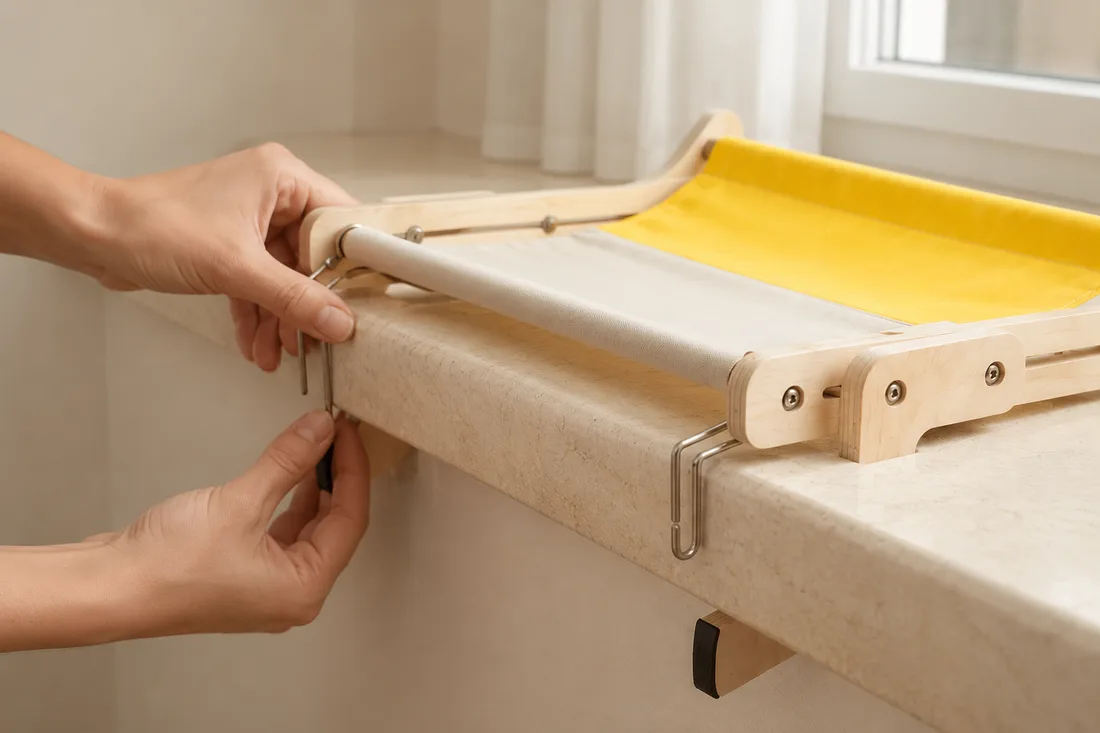
Which sills take a cat window seat, and which do not
| Sill | Works? | Mount |
|---|---|---|
| Stone or timber inner sill, older building | Yes | Clamped wooden frame |
| Fitted window board | Yes | Clamped wooden frame |
| Shallow sill, under 17 in deep | Partly | Platform on the glass |
| Sill flush to the wall, no clearance | No | Platform on the glass |
| Radiator immediately below | No | Frame hooked over the radiator |
| No sill at all (sliding door, modern frame) | No | Platform on the glass |
The clamp does not know it is on a window, incidentally. The edge of a chest of drawers, a desk or a worktop takes it just as well, which is worth remembering when the window turns out to be impossible.
The radiator under the window is not a problem
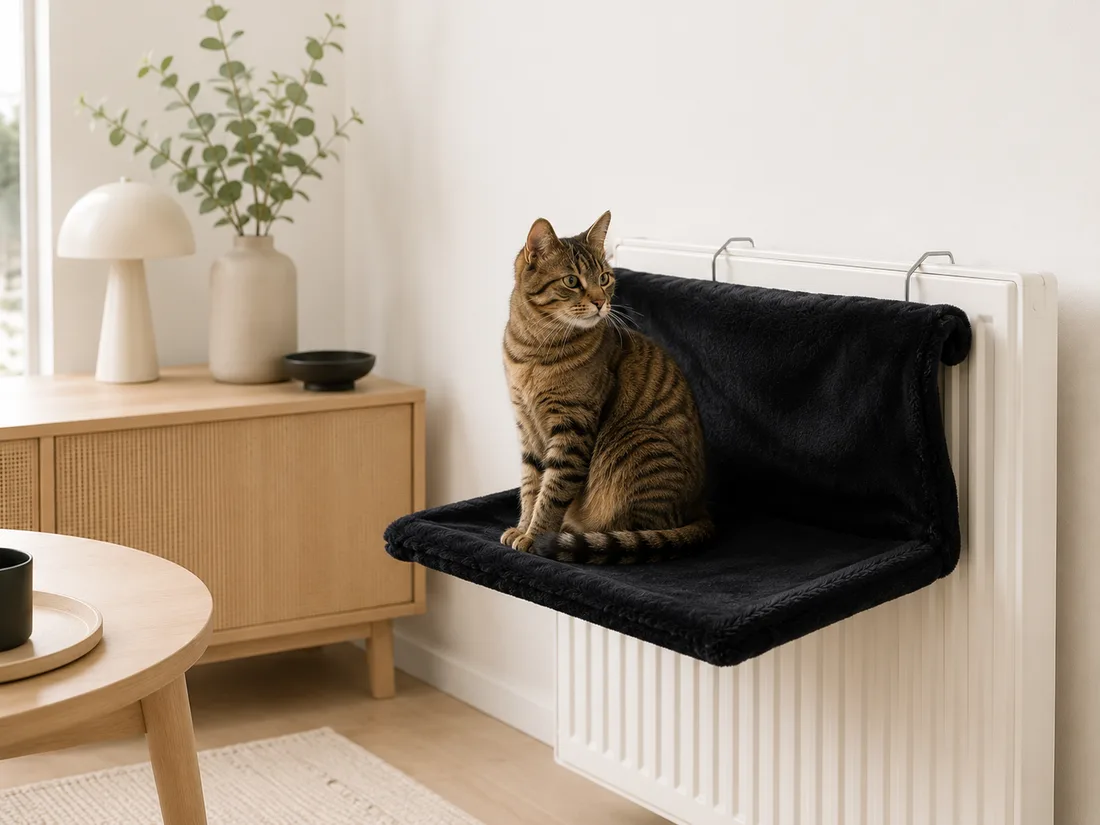
In a great many homes the radiator sits directly beneath the window, which removes the clearance the clamp needs. That looks like bad luck and is usually the opposite: the spot combines height, a view and warmth, and there is a mount made for it.
The radiator frame drops over the top of the radiator under its own weight and holds a bed 46 × 30 × 25 cm a few centimeters clear of the metal — warm air rising past it, no direct contact. The one requirement is a radiator with a gap along the top for the hooks; solid cast iron gives them nothing to grip.
Winter: cold glass and condensation
A seat at a window is more exposed than one in the room. Behind single glazing in January the pane runs cold, and a cat that liked the spot in October will quietly stop using it. Two things help: a plush surface rather than an open mesh, and moving the seat a few inches back from the glass where the sill allows it.
Condensation is the other winter question. The plywood is varnished and copes with an occasional splash, but not with standing water. On a sill that runs wet, wipe it as you would any wooden object — or use the mount that avoids the pane altogether.
Summer: the same cat window seat, the opposite problem
Sun through glass turns a solid pad into an oven. The open beige mesh lets air through and stays markedly cooler than a thick cushion in the same place, which is why it is the default for a south-facing window. Some households keep both surfaces and swap them with the seasons.
Why height matters even on a sill
pillars of a healthy feline environment — access to elevated space is one of them
— AAFP and ISFM, Journal of Feline Medicine and Surgery, 2013
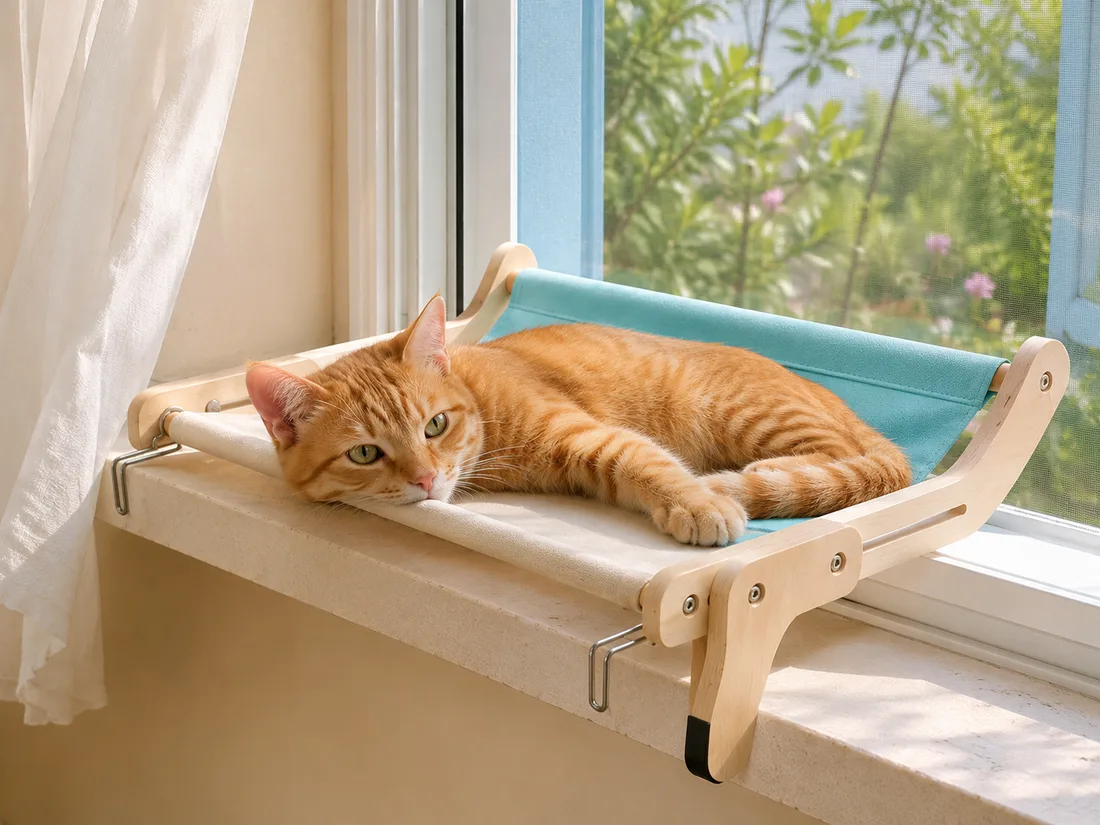
A window seat scores on all three of the criteria cats use to choose where to settle — height, warmth and field of view — which is why a hard narrow sill regularly beats a padded basket on the floor. Adding a seat mostly fixes the surface, since the position was already right.
One caveat that is about placement rather than product: a window onto a blank wall gives a cat nothing to watch, and no seat rescues that. Prefer the window with movement outside, even if it is the smaller one.
Getting up to it
A sill is often around the height a cat can reach in one jump, and often not. An intermediate step — an armrest, a dresser, the radiator itself — is what decides for an older or arthritic cat, which gives up on a height quietly, long before anyone notices. There is more on this in our guide to vertical space in a small home.
Common questions about cat window seats
How deep does my window sill need to be?
The clamped wooden frame wants a sill about 43 cm — 17 inches — deep, and roughly 5 cm of clearance underneath so the clamp can get in. If your sill is shallower than that, the suction platform mounts on the glass instead and needs no sill at all.
There is a radiator right under my sill. Does that stop it?
It can, because the clamp needs room underneath the ledge. Where the radiator sits immediately below, the frame that hooks over the radiator itself is usually the better answer — it uses the obstacle instead of fighting it.
My window has no sill at all. What then?
That is the case with most sliding doors and modern frames, and it is exactly what the suction model is for: it mounts on the glass and needs 19.9 in (50.5 cm) of smooth pane measured across the cups and arms.
Will condensation on the sill be a problem?
The plywood is varnished and shrugs off an occasional splash, but it should not sit in standing water. On a sill that runs wet in winter, wipe it down as you would any wooden object, or move the seat to the glass or the radiator.