
Cat window shelf: what drilling buys, and what replaces it
People search for a shelf because they want height without furniture. That is the right instinct; the shelf is only one way to get it, and it is the one that commits you.
What a screwed-in cat window shelf genuinely does well
Two things, and they are real. It takes the load into the wall, so a wide board can carry a large cat and stay dead still. And it can go where no window furniture can — beside a window, above a doorway, along a run of wall — which matters if you are building a route rather than a single post.
If you own the place, know what is behind the plaster and have decided where the post belongs, a shelf is a good answer.
What it costs, said plainly
The wall has to be understood. Solid masonry takes an ordinary plug. Plasterboard needs the right anchor and preferably a stud behind it, because a fixing that pulls out of a hollow wall does so with a cat on it.
The position becomes permanent. The most common reason a perch stays empty is placement, not product — a window facing a wall, a thoroughfare, a height with no step to it. A clamped or suction mount lets you test a spot and move on; a shelf makes the first guess expensive.
In a rental, the holes are the issue. Screws and plugs leave marks that usually have to be made good at the end of a tenancy, which is why so many renters land on a mount that lifts off without a trace.
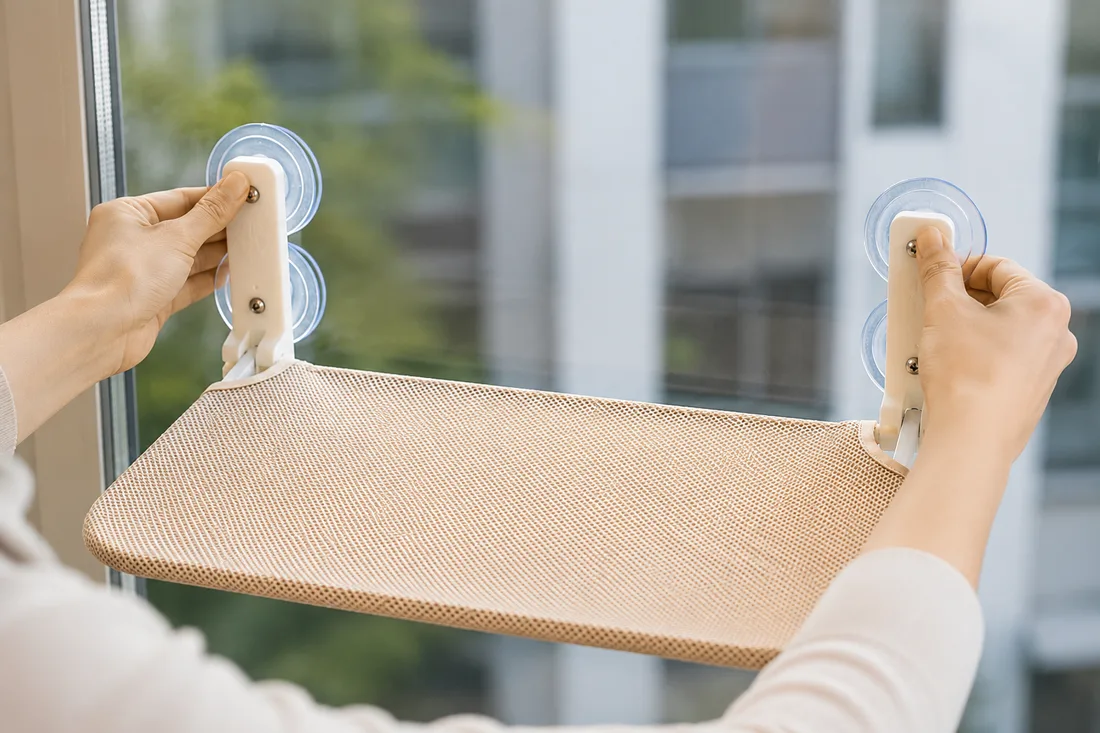
The four no-drill routes to the same height
| Mount | What it needs | Leaves a mark? |
|---|---|---|
| Suction platform on the glass | 19.9 in (50.5 cm) of smooth pane | No — lifts off, no residue |
| Clamped wooden frame | A sill ~43 cm deep, 5 cm clearance beneath | No — grips the ledge, never the wall |
| Frame over a radiator | A radiator with a gap along the top | No — hangs under its own weight |
| Furniture you already own | A cleared wardrobe or bookcase top | No — costs nothing |
All of them come apart in minutes and go back up somewhere else. In a home you will not stay in for ten years that is worth as much as the load rating, because the arrangement moves with the cat.
Height is the thing a shelf is really for
Whatever carries it, the useful marker is the same: the highest post in the home works best above the eye level of a standing adult, around 5 ft 3 in. That is where a cat stops being the one observed and becomes the observer. Below it, height still helps for warmth and for staying out of the traffic; above about six and a half feet you gain little and complicate the descent.
Most of the benefit therefore falls between 4 and 6 feet — which is exactly the band a window occupies, and the reason a window mount competes with a shelf at all.
A cat window shelf on its own tends to stay empty
This is the failure people report most, and it is not about the shelf. A cat does not travel from the floor to a point four feet up in one move: it takes a route, a series of footholds that climb and come back down. Three surfaces at 16, 32 and 48 inches beat one at 60.
A shelf also has to offer a way down that is not the way up. A board with no neighbor is a dead end, gets used for two days and is then abandoned — and in a multi-cat home, being cornered up high is a position cats avoid on principle. Our guide to vertical space in a small home works through how to build the route with furniture you already have.
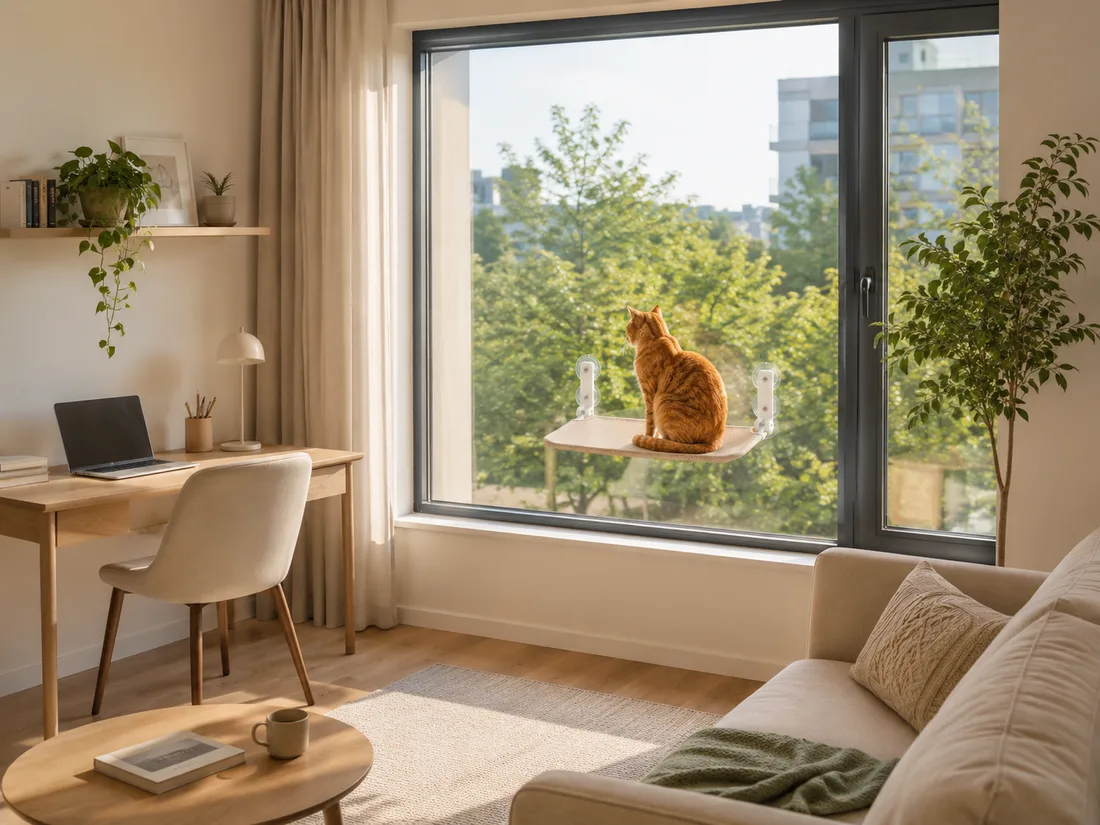
Where the shelf idea and the window meet
If what you want is a board at height near the window, the suction platform is the closest equivalent: it mounts on the glass itself, needs 19.9 in (50.5 cm) of smooth pane across the cups and arms, and puts the cat in front of the view rather than beside it.
If the window has a projecting sill, the clamped wooden frame uses the ledge as the load path — the same principle as a shelf, borrowing the joinery instead of the wall. And where a radiator sits under the window, the radiator frame turns the obstacle into the mount.
The comparison of the three sets out which suits which window.
Fitting a suction platform so it behaves like a shelf
One habit does most of the work: press the cups onto clean, degreased glass. Greasy glass will not let the vacuum form, and a cloth with a little warm soapy water is enough. Load the platform by hand before letting the cat up, and wipe the cups and the pane every two or three months — a cup that starts creeping a few millimeters a day is dirty rather than worn out.
Common questions about cat window shelves
Is a screwed shelf stronger than a suction platform?
A shelf transfers weight into the wall, so its strength depends on the wall and the fixings rather than the shelf. A suction platform holds on the glass and is limited by the seal instead. Both are stable when correctly fitted; the difference is what happens when you want to move it.
Can I put a shelf up in a rental?
Screws and plugs leave holes that usually have to be made good when you leave. That is the practical reason most renters end up with a clamped or suction mount instead — they come off without a mark and move with you.
What if my wall is plasterboard?
Plasterboard needs the right anchors and ideally a stud, and a shelf that pulls out of a hollow wall does so with a cat on it. If you are not confident about what is behind the plaster, a mount that does not load the wall avoids the question.
Can I get shelf height without a shelf?
Yes. The point of a shelf is height with no floor footprint, and a window gives the same thing: the suction platform mounts on the glass, the wooden frame clamps a sill, and both sit in the 4 to 6 foot band where most of the benefit is.