
· Harper Caldwell
Why do cats chatter at birds?
Your cat sits at the glass, a bird lands, and it starts making a noise you hear at no other moment of the day. The question that follows has a short answer and a long one, and the short answer is that the research does not settle it.
What the sound actually is
Before any explanation there is a description, and on that point the literature agrees with itself. The review of feline vocal communication published in 2020 in the Journal of Veterinary Science catalogues a sound in which the cat rhythmically clashes its jaws, producing a low-amplitude smacking noise, mostly voiceless.
The same review describes the movement more precisely: a quick stuttering or clicking of the jaw, with the mouth held tensely open. It usually comes in sequences, which can mix chatters of different intonation with other sounds altogether.
Voiceless means the vocal cords do not vibrate: it puts chattering in the same bracket as the hiss and the spit, sounds researchers still count as vocalizations even though the larynx produces nothing. What you hear is mostly jaw and breath.
Where it sits in the rest of the cat's vocabulary
That 2020 review counts up to 21 vocalization types described for the domestic cat across the published literature, and says openly that the real repertoire is probably larger. Chattering is one entry on a long list, not a category of its own.
More usefully, it is one of four sounds a cat makes while watching prey. The others are the chirp, the tweet and the tweedle — three voiced sounds, against a chatter that is mostly voiceless. The review notes that nobody knows why a cat picks one voiced sound over another, since they turn up in the same circumstances.
Most of the noise a cat makes at a bird is not chattering at all: the sound that has a name in everyday speech is the rarest of the set.

Harper Caldwell · Feline behaviorist — founder of Sunbask
Harper works with households living with one or more cats in flats. Her work turns on one question: where a cat chooses to settle, and why it ignores the bed you bought it. It was measuring dozens of window sills in clients' homes that led her to start Sunbask, and to the habit of publishing the measurements nobody else gives.
First explanation: prey that cannot be reached
The 2020 review's own ethogram gives chattering a single context: a cat wanting prey that is out of reach. It files the behavior under displacement — the term used when an animal, blocked from doing the thing it is set up to do, does something else instead.
Read that way, the glass is not incidental to the sound, it is the reason for it. The cat is in full hunting posture with nowhere for the posture to go, and the jaw runs on regardless.
The same review states plainly that it is not settled why cats chatter, adding only that it is triggered by excitement. That distinction carries the whole subject: an observed context is not a cause. Every chatter recorded near unreachable prey tells you when the sound appears, not what produces it.
Second explanation: copying the calls of prey
The most repeated explanation online is that the cat is imitating a bird. In the phonetic literature it appears as exactly that — a suggestion. The 2013 pilot study introduces it as something that has been suggested: that wild cats can copy the calls of their prey, and that the instinct survives in the house cat.
The observation usually cited behind it concerns another animal entirely: a three-page field note published in Neotropical Primates in 2009 by Calleia, Rohe and Gordo, titled "Hunting strategy of the margay to attract the wild pied tamarin". The margay is a small wild cat of the South American forest.
So the strongest single piece of evidence for the mimicry idea is a short report, on a different species, on another continent, about a different prey animal. It deserves its place in the discussion. It is not a finding about your cat at your window.
Third explanation: the jaw rehearsing the bite
The third account is the one you meet most often and the one with the least behind it: the chatter as an involuntary enactment of the juddering jaw movement a cat uses to kill prey quickly while keeping itself out of harm's way.
The 2013 study is useful here precisely because it records where that account comes from: it attributes it to an online article, not to a published experiment. The same paper notes that most references to these sounds are found in articles about wild cats, or on cat-related pages on the internet.
That is not a reason to discard it, only to label it correctly: an explanation that sounds mechanical and satisfying can still be waiting for its first measurement.
Why cats chatter at birds: how much has actually been measured
Very little, and the size of the dataset is the most useful number in this article. The 2013 pilot study collected 257 vocalizations from three domestic cats — siblings from one litter, recorded in their own home between December 2012 and March 2013 — while they watched birds through the window.
Of those 257 sounds, 22 were classed as chatter. The great majority, 169, were chirps. And within the 22, the acoustic analysis found a fairly large spread in both pitch and duration, which is another way of saying the category is not tidy.
The 2020 review goes further and warns that the published acoustic figures for chatter should be treated carefully, because they may describe chirping instead. Three cats, one winter, one window, and a caveat on the numbers themselves: that is the whole quantitative base under a behavior everyone has an opinion about.
What the chattering tells you about the post you gave it
Strip the explanations away and one thing survives all three: the behavior needs a target, and a place to watch it from. In the 2013 study the rig sat next to a large window with bird food outside, and the sounds came when there was something to see.
Which makes chattering a genuinely useful signal in your own home. It marks the window that is working. A cat that chatters at one particular pane and never at the others has told you which view holds it, and that is the pane to furnish.
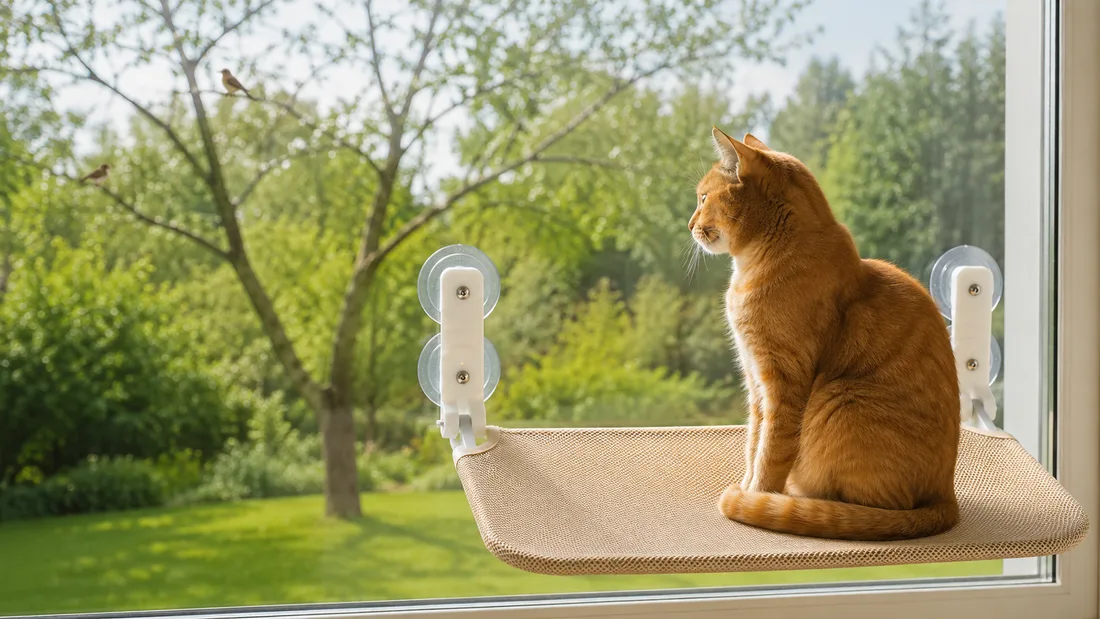
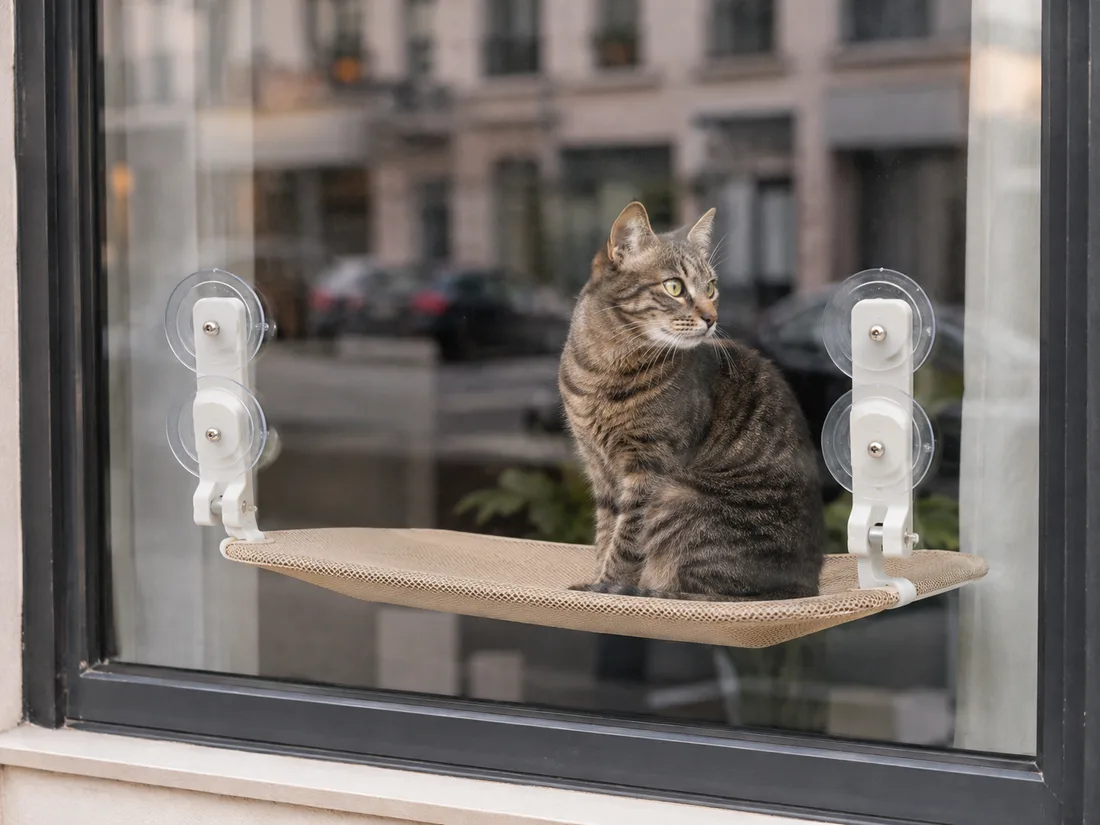
Furnishing it is the part you control. A ledge is usually too narrow to settle on and often cold, so the cat watches in short bursts, standing. A suction-cup hammock on the glass puts a stable, insulated seat at the exact height of the view, and the cat stays for the hour rather than the minute. If your window has a usable ledge, the frame that rests on the sill does the same job from below, and the comparison of the three mounts says which suits which window.
The glass between them
There is one practical point that follows from the situation itself. A chattering cat is fixed on something outside, and while it is fixed it is not measuring the drop below it. That holds for the calmest animal in the world.
The window in the photograph above is closed, and that is the state a chattering cat is safest in. If you air the room, the opening needs handling on its own terms — our guide to cat-proofing a window goes through what holds and what only looks like it does.
A comfortable post behind fixed glass answers both halves at once: the cat gets the view it is chattering at, on the side of the pane where nothing can go wrong.
When it stops being about the bird
Chattering at a window, at a fly, at a squirrel is ordinary. It becomes a question for someone else when the context drops out of it: repeated jaw movements with nothing to watch, or chattering that arrives alongside a change in appetite, grooming, or how much the cat wants to be handled.
Repetitive jaw and mouth movements have causes that have nothing to do with birds, and those are questions for a vet. If any of that describes your cat, book the appointment first and come back to the window question afterwards.
For everything else, what you are watching is a cat doing the thing an indoor cat has least opportunity to do. Our guide on how cats take to a hammock covers the days before it settles on a new post, and vertical space in a small home covers where the posts go.
The three numbers under all of this
vocalizations recorded from three domestic cats watching birds through the window
— Schötz, Proceedings of Fonetik 2013, Lund University, 2013
of those 257 sounds were classed as chatter — 169 were chirps
— Schötz, Proceedings of Fonetik 2013, Lund University, 2013
vocalization types described for the domestic cat across the published literature