
Cat wall hammock: which surfaces a suction mount holds on
This page exists because "wall hammock" covers two different intentions: fixing something to masonry, and getting a hammock up at wall height without furniture. They have different answers and it is worth separating them.
How a suction cup actually holds
Pressing a cup expels the air behind it; atmospheric pressure on the outside then holds it against the surface. That only works if the surface can hold a seal — which means smooth at the scale of the rim, sealed so it does not breathe, and rigid enough not to flex away.
Glass is the reference case for all three, which is why every dimension we publish for that model is a glass dimension. Emulsion on plaster fails on two counts at once: the roller leaves a fine texture the rim cannot bridge, and the substrate is porous, so the vacuum bleeds away over minutes or hours.
The surfaces that qualify for a cat wall hammock
| Surface | Holds? | Why |
|---|---|---|
| Window glass | Yes | The reference case — smooth, sealed, rigid |
| Glazed tile | Yes | Fired glaze is as non-porous as glass; avoid straddling a grout line |
| Mirror, mirrored wardrobe door | Yes | Same surface as glass |
| Glass partition or balustrade | Yes | Check the panel is fixed, not free-swinging |
| Gloss-laminated panel | Usually | Depends on the finish; test with one cup first |
| Painted plaster or plasterboard | No | Textured and porous — the seal bleeds |
| Wallpaper | No | Porous, and the paper lifts before the cup does |
| Bare brick, render, concrete | No | Far too open to seal against |
The quick test at home: if water beads on it and it feels glassy to the palm, a cup will seal. If it feels like paint, it will not.
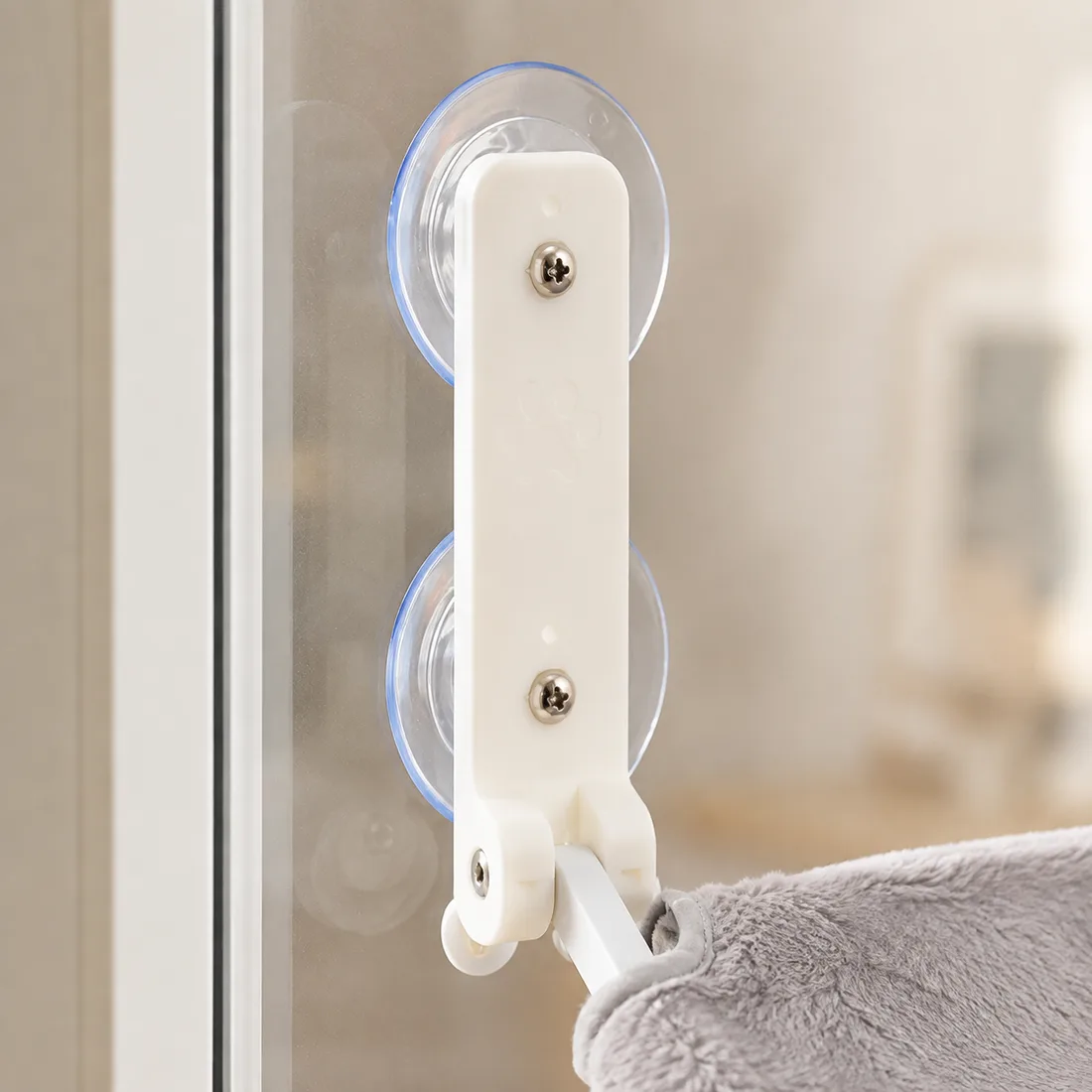
The tiled wall case, in detail
A tiled bathroom or kitchen wall is the one genuinely common "wall" that works, and it works well. Two details decide it. Keep all four cups within tile faces rather than spanning a grout line, because grout is recessed and porous and a cup half on it never seals. And check the tiles are sound — a drummy tile flexes, and a cup on a flexing tile lets go.
Beyond that, everything is as on a window: clean and degrease first, press each cup one at a time, and load the platform by hand before the cat goes up. The surface needs 19.9 in (50.5 cm) of clear smooth face measured across the cups and arms, exactly as on glass.
If what you want is fixed into the wall
Then the object is a screwed shelf, and that is a different product from a hammock. It buys a load path into the masonry and a position you cannot revise; it costs holes, a wall whose make-up you have to know, and a fixing that has to suit plasterboard if that is what is there. Our page on window shelves works through that trade in full.
Wall height without touching the wall
Two of our three mounts get a cat up at wall height while taking their load from something else entirely.
A radiator is on a wall, and the radiator frame drops over its top edge under its own weight — no fixing at all, and in the heating season it is the warmest post in the house. The requirement is a radiator with a gap along the top for the hooks; solid cast iron gives them nothing to grip.
The wooden frame clamps onto any projecting edge — a window sill, but equally a bookcase, a wardrobe top or a dresser standing against the wall. It needs an edge about 43 cm deep with roughly 5 cm of clearance underneath, and it puts the cat at the height of the furniture rather than the height of the wall.
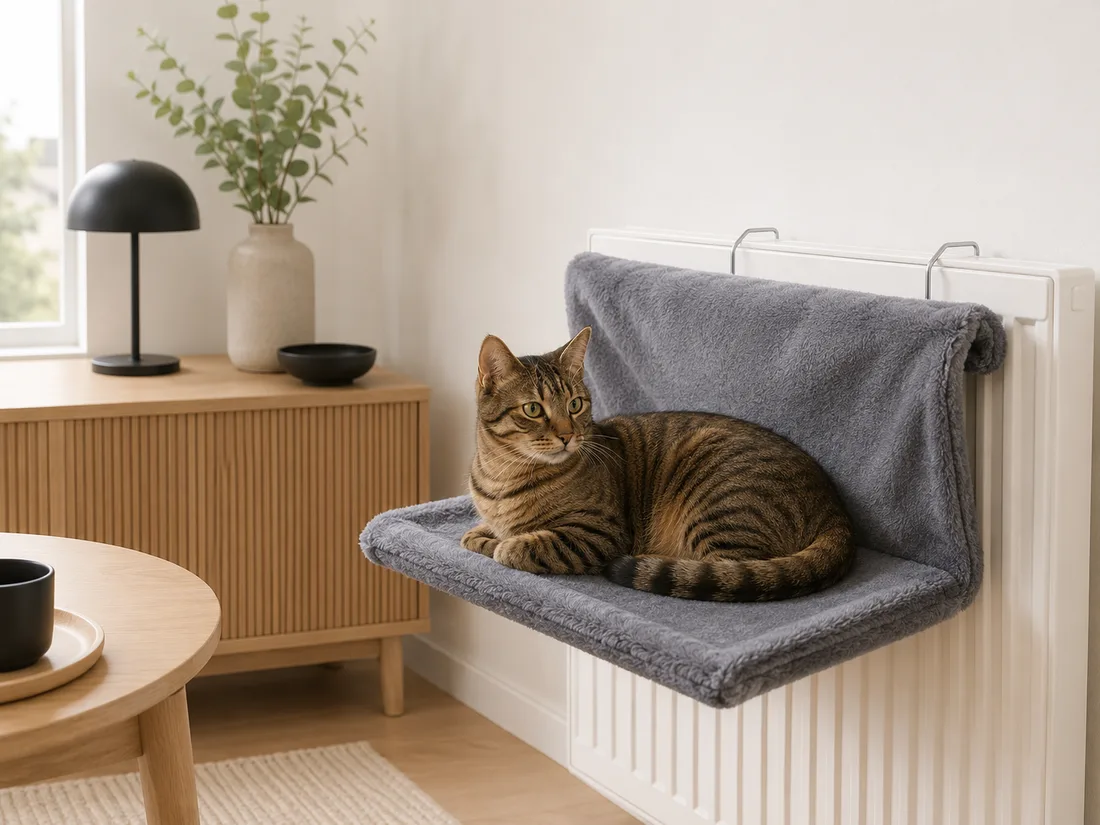
Why the window usually wins anyway
Even where a wall qualifies, it is worth asking what the cat will look at. Cats pick where to settle on height, warmth and field of view, and a wall scores on the first two at best. A post facing a blank wall gets used briefly and then abandoned — the most common reason a perch stays empty is placement, not product.
A tiled wall opposite a window can work very well for exactly that reason. A tiled wall in a windowless bathroom rarely does.
Keeping a cat wall hammock's cup mount reliable
One habit covers it: wipe the cups and the surface every two or three months. A cup that starts creeping a few millimeters a day is dirty, not worn out, and a damp cloth on both the disc and the face restores the original grip. On a tiled wall in a kitchen, where airborne grease is a fact of life, that interval is worth shortening.
Common questions about cat wall hammocks
Will suction cups hold on a painted wall?
No. A suction cup needs a smooth, non-porous surface to form a seal, and painted plaster is neither — it is slightly textured and it breathes. Tiles, a mirror, a glass partition or a gloss-laminated panel all qualify; emulsion on plaster does not.
Which walls do work then?
Any smooth, sealed, non-porous vertical surface: a tiled bathroom or kitchen wall, a mirrored wardrobe door, a glass partition or balustrade, a gloss-finished panel. The test is simple — if water beads on it and it feels glassy to the palm, a cup will seal on it.
What if I want something fixed into the wall?
That is a screwed shelf rather than a hammock, and it is a different product from anything we sell. Our three mounts take their load from glass, from a sill or furniture edge, or from a radiator.
Is there a wall-adjacent option without drilling?
Two. A radiator is on a wall, and the radiator frame hooks over it under its own weight. And the wooden frame clamps onto any projecting edge, including a bookcase or wardrobe standing against the wall.